
For many businesses, corporate value statements are little more than vague motherhood statements that sound nice but bear little relation to way business is done.
Recent high-profile scandals and crises have made it clear that many businesses do not properly or openly communicate their values.
Just look at how The News of the World phone-hacking scandal has exposed News Corp. to accusations over the company’s values and the efficacy of its leadership. Had the company more openly communicated what it stands for and the moral compass its employees follow, it likely would not have been vilified so thoroughly in the press. Despite numerous protestations from Rupert Murdoch and his top lieutenants that the company’s values align perfectly with the public’s best interests, the damage has been done. The public is left questioning what, if anything, does this company stand for?
Even NewsCorp. purports to have values, but like many other companies it fails to effectively communicate them to the outside world. Having strong corporate values is admirable, but values without proactive employee communication of their importance might as well not exist.
Corporate value statements have become real business drivers
But that’s not that case in every business. For a number of companies, corporate value statements have become real business drivers that help their companies stand out in a crowded market. They say values aren’t just window dressing, they attract customers and help retain staff.
Just ask Tony Hsieh, the American entrepreneur who founded the e-tailer Zappos which was sold of Amazon in 2009 for $928 million in stock. In a space of just 10 years, Zappos had grown from almost no sales to more than $ 1 billion in annual revenue. This was driven primarily by repeat customers and word of mouth.
Zappos has 10 core values:
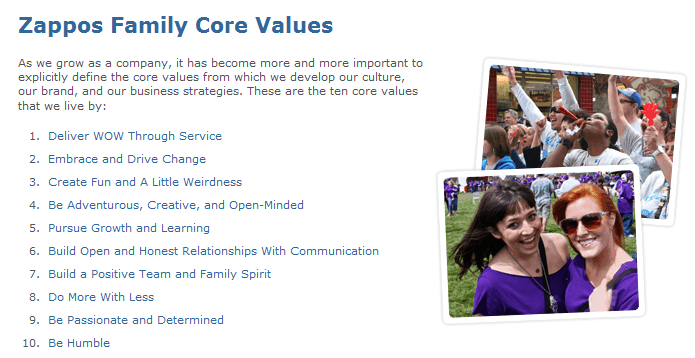
In an interview Hsieh said that the values were important to keep the company focused as it grew.
When we moved the company to Vegas, we were hiring a lot of people very quickly due to our rapid growth. It wasn’t scalable for us to be involved with every new hire decision, but the problem was that because we had so many new employees, not everyone knew exactly what we were looking for when we said we were looking for a culture fit.
Someone from our legal department suggested that we come up with a list of core values to serve as a guide for managers to make hiring decisions. I thought about all the employees I wanted to clone because they represented the Zappos culture well, and tried to figure out what values they personified. I also thought about all the employees and ex-employees who were not culture fits, and tried to figure out where there was a values disconnect.
Even though our core values guide us in everything we do today, we didn’t actually have any formal core values for the first six or seven years of the company’s history. It’s my fault that we didn’t do it in the early years, because it was something I’d always thought of as a very “corporate” thing to do. I resisted doing it for as long as possible.
I’m just glad that an employee finally convinced me that it was necessary to come up with core values – essentially, a formalised definition of our culture – in order for us to continue to scale and grow.
What can businesses do to better communicate their values? A few key ideas to keep in mind:
#1 – Establish core values across the company, not just within management
If management sets values, who would own them? You need buy-in from employees; they have to feel a certain ownership over value creation.
#2 – Words mean different things to different people
Words mean different things to different people. Therefore, it is important that the words used to define the values be simple, clear, and easily understood by the constituents and are not jargon. This leaves no room for creative (mis)interpretation of the values and avoids using words that have different meanings or can’t be translated in other languages.
#3 – Teach employee what the values mean
This must come from the top. Credibility is truly at the core of building a values-driven culture.
Employee communications has to be at the forefront of your value-setting agenda; too often, executives fail to proactively seek employee input and buy-in before values are put in place. This leads to antipathy and resentment among those employees who don’t feel a company’s values align with their personal and professional aspirations.
#4 – Your values must be non-negotiable
The moment you make one exception, you’re doomed.
#5 – Live your values
Embrace the corporate values and be mindful of them in every decision you make – both in good and bad times. Never forget that actions speak louder than words.
#6 – Make values a primary filter for performance evaluations
There is no stronger lever for promoting a culture than tying adherence to its values to individual compensation.
Short URL & Title:
Stand out in a crowded market through corporate value statements — http://www.torbenrick.eu/t/r/vfa
Share it:
If you enjoyed this article, please take 5 seconds to share it on your social network. Thanks!









About The Author
Torben Rick
Experienced senior executive, both at a strategic and operational level, with strong track record in developing, driving and managing business improvement, development and change management. International experience from management positions in Denmark, Germany, Switzerland and United Kingdom