
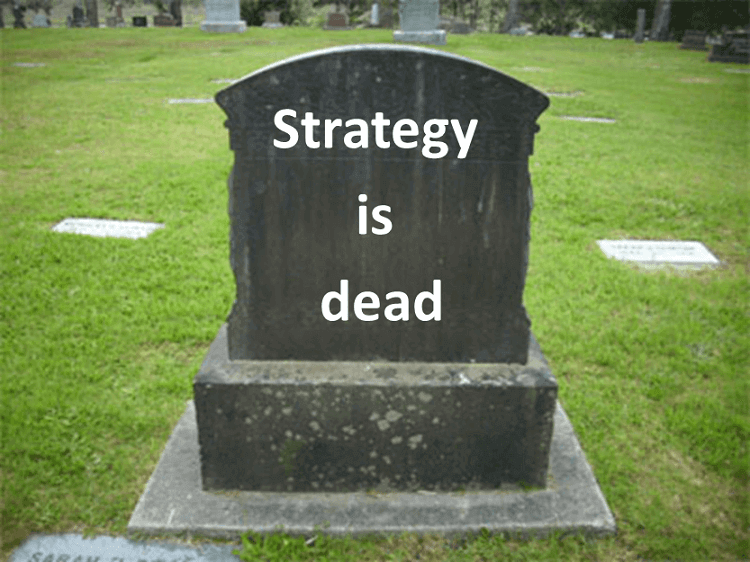
Strategy, as we know it, is dead
An article in Wall Street Journal announced, “strategy, as we know it, is dead” in the current economic environment.
Executives, it reported, were adopting “just-in-time” decision-making. There is no longer time to “predict the future” and, anyway, the future was too uncertain. Now, quick adaptation and decisions were needed. Amazingly, some companies had even created “situation rooms” to monitor current events to support quicker decisions.
At a speech to the UK Institute of Directors, the CEO of Saatchi & Saatchi (Kevin Roberts) declared strategy is dead:
Strategy is dead. Who really knows that is going to happen anymore in this super VUCA – a volatile, uncertain, ambiguous and complex – world? The more time and money you spend devising strategies the more time you are giving you rivals to start eating your lunch
Rate of change in the world today is going up
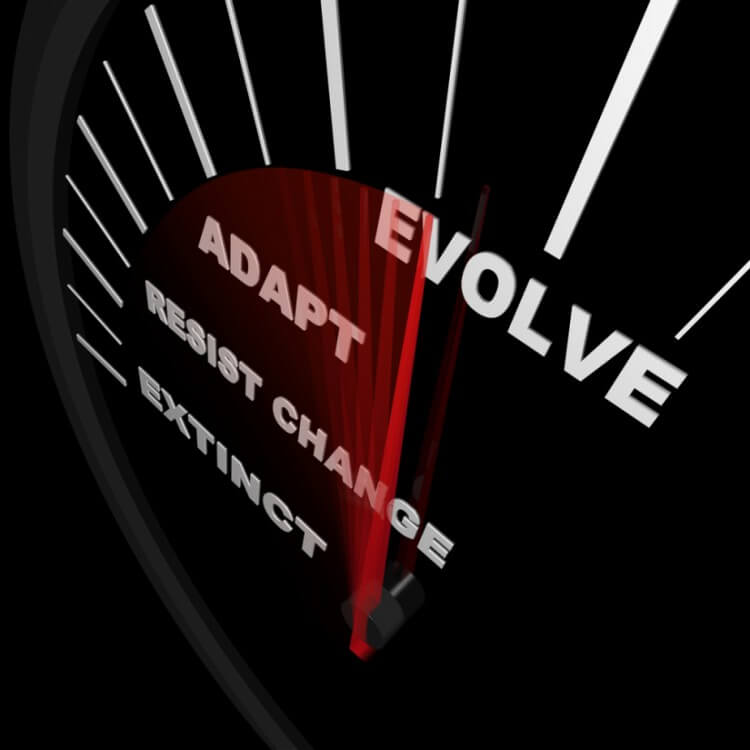
Rate of change in the world today is going up. It’s going up fast, and it’s affecting organizations in a huge way. The evidence of this can be seen almost everywhere:
- Many companies that are struggling with disruptive change – RIM, Nokia, Barnes & Noble, B&O, Kodak, Blockbuster etc. etc.
- Businesses disrupted by smartphones and tablet-PC – Digital cameras, eBooks, GPS devices, marine navigation, medical devices etc. etc.
- Disruptive business models based on collaborative consumption – books and media, car sharing, fashion, parking spot, toys etc. etc.
- The high degree of customer loyalty which was normal in the “good old days” is now just a pleasant memory of times gone by.
- The consumer decision making process has permanently shifted
- And business models can no longer be treated as stone tablets divined by wise men on mountains to last for eternity.
Things will speed up
It’s increasingly going up not just in a linear slant, but almost exponentially. And as things speed up, that means more stuff gets changing out there, and organizations to prosper have to react to that.
Companies that do the same old things, make only incremental changes, and demonstrate “me-too” thinking will get left behind in today’s rapidly changing, hyper-competitive, disruptive world.
Is the new strategy defined by the adaptability and flexibility to take advantage of any opportunity that presents itself?
Strategy as a directional tool is still valid, what companies need to do is ensure it is flexible and adaptable to meet the current environment while leaving room for further adaptation as things change.
Short URL & title:
Rapid rate of change is killing strategy — http://www.torbenrick.eu/t/r/lka
Share it:
If you enjoyed this article, please take 5 seconds to share it on your social network. Thanks!







All this applies double to governments. Ninteenth century civil structures are totally inadequate for twenty-first century governance. This is the real challenge facing democratic societies. Henry Kissenger has expressed doubt that democracy can handle the problems facing the modern world; I find it scary that such questions can be asked by credible men.
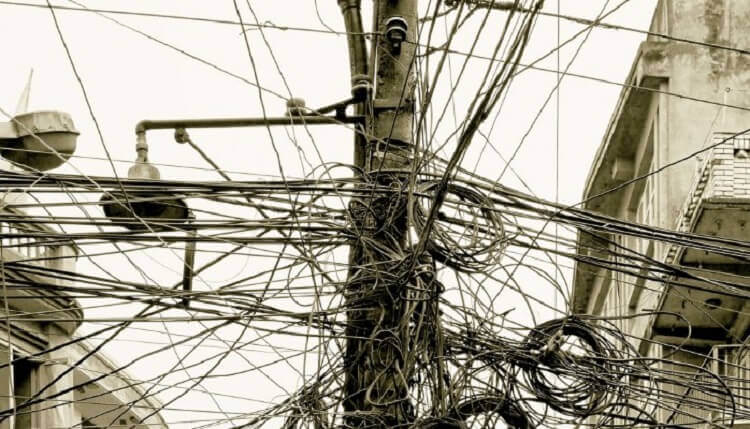
The problem as I see it is a lack of “fluidity”: companies doing things the way they have always done them and not getting with the trends. We have a classic example here in Australia: a very high profile chocolate company (Darrell Lea) has gone into receivership, and will cease trading on Sunday. The chocolate there is very old-fashioned, the sort of things my parents and grandparents would have eaten as a treat — meanwhile, we’ve switched to gourmet, high quality, fair trade chocolate (most Australian chocolate is designed to withstand being transported around in very hot conditions — which is why it tastes like brown crayons). Consumers moved; the company didn’t.Ultimately it *is* the amount of flexibility and adaptability that enables companies to survive. The idea of a “5 year plan” should have died with Chairman Mao, it’s completely inappropriate for today’s world.
Perhaps the traditional view of Strategy might be dead, the
organisational behemoth with such massive inertia that their radar has to be
able to see a long way into the future to allow it time to react.
What if there is another kind of strategy.
What if there is a strategy to create autonomy.
What if our new strategy was to create an environment that
allowed business units, even individuals, the ability to take autonomous action
to react to a particular need or set of circumstances.
There is no requirement to invest in ever more sophisticated,
and therefore expensive, radars because we no longer have a requirement to look
very far into the future.
Our autonomous workforces monitor and react to their own specific
conditions within the broad framework of
parent organisation. Each small unit, or individual, can therefore react as
fast as is required with the simple condition that the organisation supports
their ability to do so.
Strategy is not dead.
We have simply changed the goal of our strategy from a predictor
of future trends to an autonomous organisation that is so agile that it does
not need to be able to see very far ahead.Peter A Hunterwww.BreakingtheMould.Co.UK
Perhaps the traditional view of Strategy might be dead, the
organisational behemoth with such massive inertia that their radar has to be
able to see a long way into the future to allow it time to react.
What if there is another kind of strategy.
What if there is a strategy to create autonomy.
What if our new strategy was to create an environment that
allowed business units, even individuals, the ability to take autonomous action
to react to a particular need or set of circumstances.
There is no requirement to invest in ever more sophisticated,
and therefore expensive, radars because we no longer have a requirement to look
very far into the future.
Our autonomous workforces monitor and react to their own specific
conditions within the broad framework of
parent organisation. Each small unit, or individual, can therefore react as
fast as is required with the simple condition that the organisation supports
their ability to do so.
Strategy is not dead.
We have simply changed the goal of our strategy from a predictor
of future trends to an autonomous organisation that is so agile that it does
not need to be able to see very far ahead.Peter A Hunterwww,BreakingtheMould.co.uk
SteveJ A five year plan is still a good idea, but it should be regarded as a ‘stake in the ground’, a kind-of mission statement, if you like. Current activity can then be evaluated in terms of the resolved component of progress towards that target. A bit like tacking upwind in a sailing boat. And you should take advantage of wind shifts (short-term opportunities) as soon as you detect them. But unlike sailing, the location of the upwind marker should be reviewed every few months, to make sure that the company is still on a sensible course. Hmmm, I think I’ve stretched that analogy more than far enough now!)
Torben, I’m going to push back on this a bit. Strategy is not dead. The essence of strategy is differentiation. Too many companies try to compete on price or the latest technology or new packaging. Trying to be different while being the same, is no strategy at all.It is customers’ definition of value that is changing rapidly. Value begins and ends with the customer. Wealth is created when the customer gets superior value. Leaders that care about customer value and have created an organizational culture where everyone in the firm think and act constantly about what it will take create satisfied customers.
Greg Kelemen – Good point
If we would follow Henry Mintzberg from McGillUniversity who defined Strategy as “a pattern in a stream of decisions” -strategy will not die.Even when objectives are changing rapidly; there is a need for planningand realization. This means to me: We always need a strategy but we haveto speed up the realization.My point is, if changes are very often required, every company shoutwork on a business environment, where changes will become a part of thecontinuous improvement process. Today it is valuable to speed up theprocess of the strategic planning. Standardization could help to push onthis topic. Continuous monitoring of the market, searching forinnovation, collection of data for market positioning and marketsegmentation might be processes, which could be done faster. Mostimported seems to me that the management and workforce have adopted apattern how to behave and communicate if rapid changes are essential. Itis not necessarily a written process, but rather a part of thecorporate culture.Let us work on companies culture instead of doing changes only defined in projects.
Torben, I think to discard strategy and engage in short-term decision-making is obviously the wrong reaction to fluidity and change resulting uncertainty about what ‘route to take’. As Weick nicely illustrated with an example of soldiers moving though the Alps based on a map of the Pyrenees it is helpful to have a map, i.e. an idea of where to go, to guide you through unknown terrain, which can be helpful even if it is wrong map.
You need a ‘vision’ of where things are moving, an idea of where you want to go, a ‘strategy’ of how to get there and a ‘plan’ of what you should do to get there. These need to be flexible and *you* need to be adaptive to deal with unforeseen opportunities and challenges on the way.an idea where to go, i.e
Torben, I think to discard strategy and engage in short-term decision-making is obviously the wrong reaction to fluidity and change resulting uncertainty about what ‘route to take’. As Weick nicely illustrated with an example of soldiers moving though the Alps based on a map of the Pyrenees it is helpful to have a map, i.e. an idea of where to go, to guide you through unknown terrain, which can be helpful even if it is wrong map.
You need a ‘vision’ of where things are moving, an idea of where you want to go, a ‘strategy’ of how to get there and a ‘plan’ of what you should do to get there. These need to be flexible and *you* need to be adaptive to deal with unforeseen opportunities and challenges on the way.
This mirrors khaneman’s, and others, descriptions of system one and two thinking. The sub concious system one is responsive to stimuli. Responses based on evolutionary behavioural survival biases and learnt patters in past experiences. While the concious system two likes to think it is in control and determines the strategy, even if it just post rationalisation.
A truely agile company which merely responds to the stimuli in the form of actions by others will never excel. There is still a need for an agreed defined objective even if the route adapts. So a strategy which is too prescriptive and defined at a micro level is likely to fail where as a strategic approach with macro definitions of how to achieve the goal is more likely to succeed.
The rate of change is not so much the problem as the diversity and numeracy of the competitors who have access to the same instantaneous information.
I agree with Peter A Hunter, the time for grand strategies and investment plans is over. The world is rapidly changing and a successful organisation is not governed by strategies and tactical plans in a WW1-style but rather by values, goals and individual targets. In my experience time and money spent on a common set of values and common overarching goals are much more well spent than on strategic processes. This creates an organisation and individuals with the ability to adapt to a changing world.
Peter Hunter is right about creating autonomy being a useful strategy. This is why more and more companies are turning to open book principles. If the employees understand the company economics, they are empowered to use their autonomy in ways that improve the company economics, generating profitable growth. As Peter correctly describes, this is a strategy.
Beyond this, given that the pace of change is rapid, it would make sense to shorten the strategic planning time frame. But abandoning strategic planning would also be a strategy, just a very bad one.
However, one successful strategy is to be fast adoptive to changes!
Also needed is a heading. Its scary to be out on the big ocean without any ide were to strive to!
Think this is still applicable: If the speed of change outside exceeds the speed of change inside, the end is in sight. Think Jack W. said this words 20 years ago!