
Organizational change – Reasons why people resist change
Expecting resistance to change and planning for it from the start of your change management progamme will allow you to effectively manage objections.
Understanding the most common reasons people object to change gives you the opportunity to plan your change strategy to address these factors.
It’s not possible to be aware of all sources of resistance to change. Expecting that there will be resistance to change and being prepared to manage it is a proactive step. Recognizing behaviors that indicate possible resistance will raise awareness of the need to address the concerns.
Classic psychological reactions to change
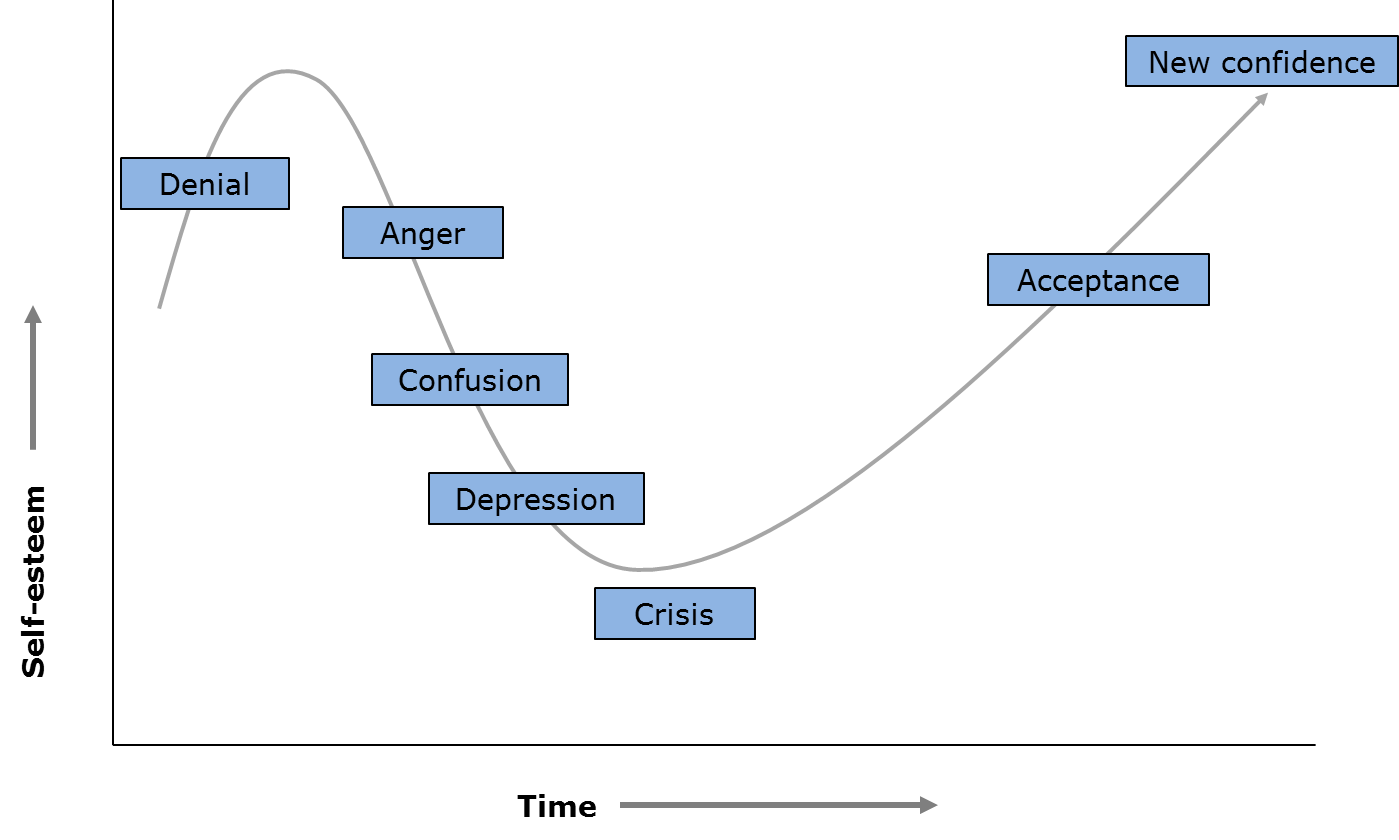
At the end of the day all sources of resistance to change need to be acknowledged and people’s emotions validated.
It’s far better to anticipate objections than to spend your time putting out fires, and knowing how to overcome resistance to change is a vital part of any change management plan.
Top 12 typical reasons for resistance to change
- Misunderstanding about the need for change/when the reason for the change is unclear — If staff do not understand the need for change you can expect resistance. Especially from those who strongly believe the current way of doing things works well…and has done for twenty years!
- Fear of the unknown — One of the most common reasons for resistance is fear of the unknown. People will only take active steps toward the unknown if they genuinely believe – and perhaps more importantly, feel – that the risks of standing still are greater than those of moving forward in a new direction
- Lack of competence — This is a fear people will seldom admit. But sometimes, change in organizations necessitates changes in skills, and some people will feel that they won’t be able to make the transition very well
- Connected to the old way — If you ask people in an organization to do things in a new way, as rational as that new way may seem to you, you will be setting yourself up against all that hard wiring, all those emotional connections to those who taught your audience the old way – and that’s not trivial
- Low trust — When people don’t believe that they, or the company, can competently manage the change there is likely to be resistance
- Temporary fad — When people belief that the change initiative is a temporary fad
- Not being consulted — If people are allowed to be part of the change there is less resistance. People like to know what’s going on, especially if their jobs may be affected. Informed employees tend to have higher levels of job satisfaction than uninformed employees
- Poor communication — It’s self evident isn’t it? When it comes to change management there’s no such thing as too much communication
- Changes to routines — When we talk about comfort zones we’re really referring to routines. We love them. They make us secure. So there’s bound to be resistance whenever change requires us to do things differently
- Exhaustion/Saturation — Don’t mistake compliance for acceptance. People who are overwhelmed by continuous change resign themselves to it and go along with the flow. You have them in body, but you do not have their hearts. Motivation is low
- Change in the status quo — Resistance can also stem from perceptions of the change that people hold. For example, people who feel they’ll be worse off at the end of the change are unlikely to give it their full support. Similarly, if people believe the change favours another group/department/person there may be (unspoken) anger and resentment
- Benefits and rewards — When the benefits and rewards for making the change are not seen as adequate for the trouble involved
Expecting resistance to change and planning for it from the start of your change management progamme will allow you to effectively manage objections. Not dealing proactively is one pitfall – but there are many other common mistakes.
If you have any inquiries about where and how to use Uptown Aces Bonus, you can contact us at our own web-site.
Short URL & title:
Top 12 reasons why people resist change — https://www.torbenrick.eu/t/r/hwj
Share it:
If you enjoyed this article, please take 5 seconds to share it on your social network. Thanks!









Excellent blog post.
Change in my experience is one of those areas that seems simple in theory but tough in practice. The key in my experience is to change hearts and minds.
Duncan Brodie
Goals and Achievements Ltd
Nice thoughts, All relevant….
well said at the end that “To win people’s commitment for change, you must engage them on both a rational level and an emotional level”. Something I too believe in.
Surabhi Rastogi
Draft n Craft
I have posted this list previously on the web, but it bears repeating. It reinforces what you are saying with your list of 12 items.
In my experience, here are the top 5 enablers or assets that assist change, followed by the top 5 obstacles to change.
Top Enablers/Assets:
1)Your organization and you are experiencing a crisis, perhaps one that threatens your existence and, like a tsunami coming ashore, relentlessly drives you before it.
2)Everyone is focused on that crisis. Have you ever been on a plane and heard a loud “boom!”? Everyone goes quiet; people look around or at each other, and wonder “What was that?” They are alert and prepared to meet the danger.
3)Leadership that shows the way forward, and channels peoples’ fears and panic, hopes, dreams of survival and better days, and energies.
4)A willingness to “link arms” and work together to emerge from the crisis together.
5)A strong survival instinct, where the tagline is “failure is not an option.”
Top Obstacles to Change:
1)A comfort level or even fixation with the way things are, remarkably, no matter how miserable or painful. People would rather complain than change.
2)A fear of the unknown, or better the devil you know than the devil you don’t know.
3)Weak or non – existent leadership.
4)Infighting.
5)The belief that failure is a perfectly acceptable option, and maybe even the preferred solution.
Excellent list and explanation! Awareness of these reasons why people resist change can go a long way towards overcoming that resistance. Seeking input, communicating plans, and listening to concerns go a long way towards resolving many of these obstacles to successful change implementation.
Thanks for sharing!
Chris
Last sentence is key for me. Too many people assume that because the business case and rationale stacks up people will change. Emotional engagement trumps rationale every time
I would suggest these traits of management style that set the environment for failure. Communication, Trust, competence, “old ways” etc. re enforce a stagnant culture. As we all know, if management isn’t demonstrating the behavior that is desired, why would anyone else??
The last sentence replaces the rest of the article.
When the workforce are engaged with change they will support it.
When they are not they will resist it.
If we know how to engage the workforce we will do so and experience the amazing experience of working with the workforce instead of against them.
If we don’t know what to do to allow the workforce to engage we will continue to look in lists like this for the things that we can do to them to prevent them from resisting what someone else wants to do to them.
Engagement is not something we “do” to others to achieve an end.
Engagement is the way that people feel about what they do and we can’t change that.
What we can do is to create the environment that will allow people to engage, then they will choose to engage, we can’t make them.
Peter A Hunter
There is one more source of resistance, though maybe something on this list is meant to cover it. The loss or threat of loss of something important. Sometimes the uncertainty of what will be lost generates the fear and resistance. Sometimes what is being lost, is very clear, e.g., power and control, privileges or benefits, status, identity, and of course many other possible things. When change takes something away that is important, some kind of resistance may arise.
Excellent article! Change is hard for many people and requires repeated reassurance, very clear communication for both management and staff as well as a great deal of patience in order to achieve long-lasting results.
Such common sense, yet so often forgotten. Thanks for the reminder
The graph is more powerful than the 12 reasons from trainer’s perspective.
The gross presumption of the writer and management attendees of the article is not surprising considering the degree of dysfunctionality of the worldview presented. If the cause for change comes from management itself, that management itself operates from fallacious principles, then resistance is necessary. If a workforce is subject to abrasive, belligerent, and threatening management then common morality and ethics mandates resistance. The hypocracy of modern American business is that while persons in management conduct their own lives under common conventions of social contract and morality, they demand to be excused from the same conventions in the business place — they insist on treating subordinates in any manner they please for the good of profits, stockholders, or the mere ego of the CEO. Moreover, the perspective of the writer assumes that might is right, that authority bears no responsibility in its actions…as long as the flow of authority is maintained. I submit that this cancerous false pride within American management is ‘the’ poison pill that has brought our nation to its knees economically. Without ethics and morality in business, the pursuit of profit becomes a workplace nightmare. With millions upon millions of Americans unemployed by no fault of their own, the premise of this article is beyond preposterous.
Great list, Rick. I’ve seen all of these at work in various projects and changes over the years. Communicating effectively with people, building trust, selling the benefits, and making the change as easy as possible for them, are so important.
I agree whole heartily with Duncan Brodie, I have implemented changed from the heart, but first It all starts in there minds. Gaining trust and giving them confidence.
excellent article …
Experience is also a reason. When people have experienced that change causes problems and offers no improvement on their situation (but is done for the sake of change and the managers bonus) it is common sense to resist change. Ethics, culture and integrity breed acceptance.
The reason why people resist change in organization. I really enjoyed this tips and it has really exposed me to some things like the self – esteem (the denial, anger, confusion, depression, Crisis, new confidence, and acceptance.
Torben
I have read this blog a number of times and every time I do I become more convinced that its not resistance to change is the problem but a failure to gain the buy-in or commitment of the people impacted by the change. Taking the view that they are not the problem its ua who need to change the way we manage change can establish a very different dynamic. How often do we see engagement in the form of more one way communications, more spin and more trashing of the past. One organisation that carries its pride in the past and moves on is the military with medals, banners etc. Bridges Transition Model offers a very useful approach of acknowledging the past before moving on. Is failure to do that reason 13…..
Awesome perspective.
Prior to the 1930’s “resistance” referred to manifestations in physics, e.g. friction and ohms. It began to be used as a human phenomenon in two contexts. One was the idea of collaborative (if not coordinated) collective opposition to something, usually suggesting illicit basis, e.g. resistance fighters in WWII, to distinguish form simply opposition. The other use was from psychology to explain a phenomenon in a patient who – in an UNCONSCIOUS way – avoided confronting what seemed “true” distressing forces (at least as appeared to the therapist). There are still those in psychiatry and psychology who question the accuracy/legitimacy in practice. It has passed into pop cliche (e.g. Denial isn’t just a river in Egypt). Notably, George Vaillant, Harvard psychiatrist and one-time head of a longitudinal study of what distinguishes men’s levels and natures of success or failure over decades. JFK was among its original subjects. The sample was small because the study was begun prior to WWII so they stopped adding new subjects by 1943. He wrote a remarkable book, “Adaptation to Life” in which he used the term instead of resistance to identify 17 ways in which people’s sub/unconscious protected them from what they believed was existential harm. Some are very common, and many are used to maintain mental health at times throughout one’s lifetime. More specifically adaptations include fantasy, sublimation, projection, sublimation etc. They determine how people respond to personal crises, and may vary over time. None is necessarily dysfunctional unless maintained neurotically. For example, fantasy is a common and healthy defense mechanism for children who really experience senses of threat from angry or critical parents, teachers, etc., let alone actual physical harm who have no way of avoiding or fighting back. If it is a key adaptation for people over 30 it perpetuates avoiding dealing with issues problems (internal and external) in a way that is less healthy. One key exception, “verified” by accounts of Holocaust survivors of concentration camps and prisoners of war in general, where fantasy may be the most available form of occupying the mind and soul beyond the immediate conditions. Hence my questioning the over simplification of the graph of reaction to change.
Worse in OD and CM is that resistance is used to connote a group reaction. If the only psychological manifestation is -by definition – an ego defense, a problem arises. Groups have no egos, certainly not aggregately subjected to complex dynamic of ego in the same way at the same time. In this sense it is sloppy thinking that is now supported by sloppy language. The issue, btw, is less about definition than distinction. How we know things are actually different and/or unique is by distinction not definition for anything abstract (though the two may be identical words concrete objects).
William Bridges who spoke of Transition to distinguish what he was talking about from Change as conventionally viewed recognized – without referring to “resistance” – dynamics at play that persisted not just going into change, but well after the organizational change was “completed.”
There is also a subtext for many that “resistance’ is a characteristic of people in a client system having little to do with whether the consultants or managers failed in what they did.
The reasons are closer to identifying what is going on, but to bunch them together as causing resistance seems misleading as opposed to calling things what they may be: unclear understanding (but NO mention of unclear or insufficient explanation!), doubt, inappropriate rewards for the effort, and one not mentioned: the proponents of change refusing to consider that may be suggestions for better alternatives by the “changees.” Why bundle all this as resistance?
This is a great and clear explanation of the ‘classical’ challenge of change. I’m going to add a however here – however it doesn’t have to be this way, if you start with a different paradigm.
if you start with a view that most people, most of the time are actually fully open to change, when the right conditions are present, then most if not all of these resistance elements disappear.
And the different paradigm is that the change instigator has to accept that they don’t have the answers to how the change should play out.
So they will need to ask people to engage, rather than tell them and expect them to follow. This is easy to write and incredibly difficult to do!
Because the biggest change starts with the change owner. And they are the ones most likely to resist…
People don’t resist change. Look at their private lives and see the changes ‘they’ have made over the last 5 years.
The key to understanding this problem is to realise that people don’t resist change; they resist ‘BEING CHANGED’. All you have to do is put people in charge of their own change process. Give them some simple problem solving tools (not six sigma), a clear direction for the required changes/improvements (*P.Q.C.D.D — 4 D’s — E.F.S.F), time to address the issues in teams of **‘Real Experts’, a supportive management attitude and then get out of their way. You will be amazed by the results. You can see this process in operation on You-tube under ‘Sid’s Heroes’. This an extract from a six programme TV series we made with the BBC in 1994,
Good luck releasing your own Heroes.
*For the business. — Improve Productivity and Quality. Reduce Costs and Delivery times. Delight Customers. (All these values must be improving faster than any existing or future competitor).
* For our machinery, processes and systems; Zero – Downtime, Delays, Defects & Damage to our people (Accidents).
*For themselves. — Make their jobs, Easier, Faster, Safer and more Fun/enjoyable.
*We must create companies that can win on the global battlefield, and are secure, challenging and enjoyable places to work.
**‘Real Experts’ are the people who do the work, and have first hand experience of the different elements of the problem to be solved, or the situation to be improved.
The survival of your organisation and the job security of your people depend upon you improving these values faster than any existing or future competitor.
Before we start a programme we conduct a series of 1 hour briefings (10 sessions a day with 25 people/ on each) with the people who will be involved in the change programme to ask for their help. We explain the above to delegates, and while they don’t always believe me, when I ask them would you like to, the answer is always ‘Yes’. The rest is just letting them prove they are the ‘Heroes’ I know them to be. Watch the video to see where my confidence comes from.
Dear Torben,
Thank you for sharing this. In my opinion the key to change is to make the change desirable.
First priority are the must do’s of being transparant, honoust and to emphasize with normal human response.
A lot of companies who try to change things didn’t inform the staff in time about culminating issues and challenges and didn’t involve employers to create clever solutions!
This is critical in the process of change. Keeping adults out of important facts is treating them like they are little children who lack the brain capacity and skills to come up with good ideas and suggestions. How different form Ricardo Semler’s very succesful Semco Sa organisation in which he shares the financial reports to every single staffmember and even provides training in how to read those reports. They also choose their own managers and evaluate them publicly.They increase result improvements of at least 20% every year.
We need to involve them long before the process of change is started. That’s the first big change to make and I am sure nobody of the staff will resent it. When tough issues demand very good decisions it’s very helpful to involve represents of all layers in the organisation and challenge them to think with their colleagues about clever and creative solutions and best choices.
Then I am sure you will find enough desire in your people to create the neccessary change, and more, much more good things for the future!
Sorry, typo in paragraph 3, I mean employees where it did write employers, so please understand it’s about your employees!
The analysis and listing of reasons for resisting change are all valid. However the tone of the article is about changing someone else. All of us, everyone who is one this forum has resisted change ans still resist change in some for or other. It is often true that we people who advocate change for others forget to apply the same principles in our lives. In fact talking about issues of change becomes an escape for us to making that change in us. Some year ago when I used to work with an organization some of my colleagues used to complain that nothing is going to happen here. I responded, “Are you willing to put your neck on line to make the change that you wish to Happen?”
We can expound profound theories of change and have grand discussions. Real Change can only happen when one is ready to risk everything for that cause. Gandhi said, “Be the change that you want see in the world”
It seems to me I was exposed to a new one during my last assignment. I describe it as “I know what that is about and I know all I need to know about it so I do not need to be part of the change” attitude, so leave me alone.
I’d like to hear people’s opinions on a business’ management team deciding growth and change is necessary and desirable and once initiated then refuses to change whilst still acknowledging it’s needed. What’s the solution if the whole business agree change is necessary and are on board and then face opposition from the instigators of these changes in the first place?
Thanks for sharing those ideas to us! I do all agree with the 12 reasons for resistance to change. Anyway, I would be appreciate if you could please explain more about the graph “Classic psychological reactions to change” and the relationship between time and self esteem.
Thank you,
Sukontha
Rick,
Thanks for packing this info, great job of keeping it simple. My experience is people resist change because it challenges their “status quo” – no matter how bad things are they know how to “play the game” and get things done. As you suggest – true engagement, from the get-go, is the key to successful change.
Change is not easy and it has advantages and disadvantages.
Woodrow Wilson stated that “If you want to make enemies, try to change something.”
People always resist change and that is expected. A good leader should anticipate this and be prepared for resistance.
I agree that organizational change management is the best way to deal with change effectively.
Organizational change management is the discipline of leading change.(Mar,2013). It is an executive or management function and it aims to reduce resistance and teach people how to accept change and embrace innovation.
The classic reactions to change show us that it is not an easy task as it involves emotions such as anger, denial, confusion and depression. That is why it should be handled carefully and it requires planning and organization.
The first and most important reason for resistance to change as mentioned is misunderstanding the need for change. That is why it needs to be communicated carefully to staff and faculty members. Uncertainty can be very stressful and makes one’s imagination run wild. (Mar, 2013). Here comes the role of change management as it strives to reduce that uncertainty and reassure staff and faculty members.
As you mentioned, it is better to anticipate objections rather than put out fires because if rumors spread it would be difficult to contain the situation. Not only will rumor spread, but this may lead to fears such as job loss or other challenges that may result in the resignation of some staff members.
Low trust is also a problem, and this is when the management is not clear about the reasons for change. With this there is no accountability and it will lead to the loss of trust and that will lead to resistance and rebellion.(Mar,2013)
Very informative article as well as discussion.
Change Management is a journey and not a destination, these will not happen overnight, people must feel uncomfortable during the change execution. Communication and Buy-in of the stakeholder’s matter the most to make it an effective change. The first thing, it starts with a vision.