
How to hold people accountable
Everybody, somebody, anybody, and nobody
Does this little story sound familiar?
This is a story of four people named Everybody, Somebody, Anybody, and Nobody. There was an important job to be done and Everybody was asked to do it. Everybody was sure Somebody would do it. Anybody could have done it, but Nobody did it. Somebody got angry about that because it was Everybody’s job. Everybody thought Anybody could do it, but Nobody realized that Everybody wouldn’t do it. It ended that Everybody blamed Somebody when Nobody did what Anybody could have done.
But how to avoid this? How to hold people accountable? How to create a culture of accountability and hold people accountable? How to handle performance management?
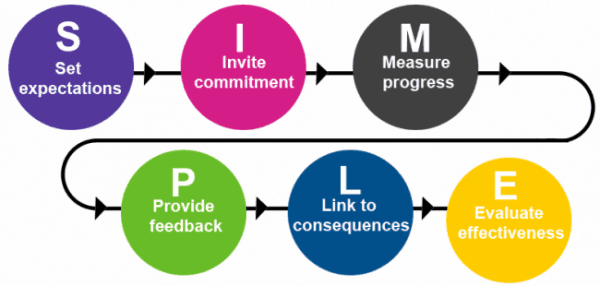
Image: Infographic: SIMPLE approach to high performance organization
Actually, it’s SIMPLE:
S = Set expectations
I = Invite commitment
M = Measure progress
P = Provide feedback
L = Link to consequences
E = Evaluate effectiveness
S = Set expectations
- The success of any organization comes down to one thing: how well it organizes its members to focus on and work toward the same purpose
- The employees need to know what is expected of them before they can be hold accountable for anything
- The more clearly the expectations and goals are set up front, the less time will be wasted later clarifying – or worse, arguing about – what was really expected
I = Invite commitment
- Just because your employees know what to do doesn’t mean they will do it. After goals and expectations are set, employees need to commit to achieving them
- Employees are more likely to do this when they understand two things: how the goals will benefit them personally, and how the goals will help move the organization forward
- Once this connection is made they are more likely to buy into the goals, and actually welcome you holding them accountable for the results
M = Measure progress
- Information is needed to hold your employees accountable. Measure their ongoing performance and gauge whether or not they meet the goals and expectations to which they had previously committed
- Goals are only measurable when they are quantified. Measure the results and compare them to the employees’ goals to discover the gaps that require further attention
P = Provide feedback
- Feedback won’t solve problems by itself, but it will open the door for problem-solving discussions and follow-up actions
- The employees need feedback to do a good job and improve in areas where performance is falling short of expectations. Most of the time, giving objective, behavioral feedback is all it takes. Setting expectations followed by quality feedback is the backbone of holding someone accountable for results
L = Link to consequences
- Sometimes employees need a little external motivation to live up to their commitments. When they struggle to reach their goals, they can be helped by administering appropriate consequences
E = Evaluate effectiveness
- Review how the process has been handled
- Put a systematic and consistent method in place and you’ll find that when people are held accountable for the work that must get done, it gets done
Goals must be tied to larger organizational ambitions
For goals to be meaningful and effective in motivating employees, they must be tied to larger organizational ambitions.
Employees who don’t understand the roles they play in company success are more likely to become disengaged. No matter what level the employee is at, he should be able to articulate exactly how his efforts feed into the broader company strategy.
High performance and success are not dependent on one simple factor or as a result of one or two things. The entire context you operate in greatly impacts your results.
Article published:
This post was published in Trud newspaper (Bulgaria) – “Проста рецепта за отговорни служители“.
Short URL & title:
How to hold people accountable – Performance Management — https://www.torbenrick.eu/t/r/rue
Share it:
If you enjoyed this article, please take 5 seconds to share it on your social network. Thanks!








Team members also need to hold each other accountable. This does not mean reporting all employee problems to the manager, but a willingness to to talk directly to a team member. It requires the skills to speak with clarity and respect to address problems before they impact quality.
Direct reports are better accountable…
Typically the accountability of peers from cross functional teams is a bigger problem. In today’s cross geographic development teams, this problem is becoming a bigger bottleneck…
I like SIMPLE. Some mnemonics are tortured affairs, SIMPLE really is simple and covers the bases nicely. Well done. I especially like I – invite comment. That often seems to be missing from conversations about performance. It’s what can turn a performance monologue into a performance dialogue.
Nice job Torben. This short piece gets to the heart of it.
Well, what about empowering people to actually (want to) be accountable?
This describes the ‘how’ of holding people accountable; however, the way in which this process is done can make all the difference. Without a good relationship with those you are trying to hold accountable this process will not work.
Torben,
Thanks for your article. I do wonder if what you have written is only half the story? What if the organisation was also interested in the success of the employee? How do you think that would fit in to your SIMPLE appoach? If you are not sure about what I mean, ask employees what they care most about (using a forced response question structure) – their personal success or the organisations?
What if employee personal motivations could be understood and enhanced by an organisation? What do you think that would do for employee motivation and accountability for organisational objectives?
These questions are particularly relevant for your ‘I’ section of your article. The assumption is that employees will commit when they understand how the organisation’s goals will benefit them. I’d argue that this is only achievable if the organisation understands what the employee’s personal goals (across their entire life) are so the synergies can then be explored and understood by both parties. Then motivation and accountability can work both ways.
Rick,
Great idea.. and as most great ideas are…yours is simple.
I can imagine developing a management workshop on performance development based on your concept.
Thank you for sharing.
Joven
Rick,
I can really relate to your ‘simple’ approach and though it was not explicitly described in your piece, I am sure you would have considered the role that leaders played in every ‘simple’ step which would articulate the ‘How’ e.g. when setting expectations How should the leader engage the organisation to get these done, and when inviting commitment How does the leader demonstrate their own commitment to the performance objectives.
Thinking the How through makes a huge difference between, just missing vs achieving vs surpassing business objectives.
thanks for this
G
Accountability is important no matter what your industry is.
It is to be appreciate, the real bases for hold some one accountable for whatever we promised to be delivered,
thank you very much for all
This article is simply amazing at explaining the problems and how to fix them. Motivation and accountability are valuable and hard to find nowadays among workers. Much respect for Torben Rick for this article.
Why do so many management articles pre-suppose that what the leaders are trying to get their employees to do is perfect and that those very leaders are also perfect. For example if an employees sees that the leader is wrong and communicates this in a reasonable way ( and lets assume the employee is “right”), nearly always the leader can handle the situation badly. I believe most problems of performance management start with expectations not being communicated correctly or even being reasonable in the first place!